China Top 10 DDR5 Manufacturers DDR5 Architecture Explained

Time:2026-10-28 Author:Sophia
0%

DDR5 is reshaping memory design across servers, PCs, workstations, and high-performance computing. TrendForce projected that DDR5 would exceed half of global PC DRAM shipments in 2024, showing how quickly the standard is moving beyond early adoption. JEDEC’s JESD79-5C specification defines the foundation: higher data rates, two independent 32-bit subchannels, on-die ECC, and a standard 1.1V operating voltage. These details matter inside every module.

For readers searching “DDR5 architecture explained,” the key question is not simply speed. DDR5 changes how memory transfers, manages errors, distributes power, and serves multiple workloads. Rambus Fellow Steven Woo has described DDR5 as “more than just a speed bump.” That observation is useful, although real-world gains still depend on latency, memory channels, firmware, and processor design. Faster numbers can mislead.

This guide examines China’s leading DDR5 manufacturers through that architectural lens. It considers design capability, packaging, module reliability, production scale, and ecosystem support. Industry reports from TrendForce, Omdia, and JEDEC provide the broader market context, while manufacturer specifications help separate tested performance from promotional claims. CXMT’s progress in advanced DRAM attracts attention, while Chinese module companies compete through validation, thermal design, and supply responsiveness. The market remains uneven. Some product claims need independent testing.

A careful comparison should inspect memory density, PMIC implementation, SPD hub behavior, error-correction features, and platform compatibility. A module may look impressive on paper. Your workload may disagree.
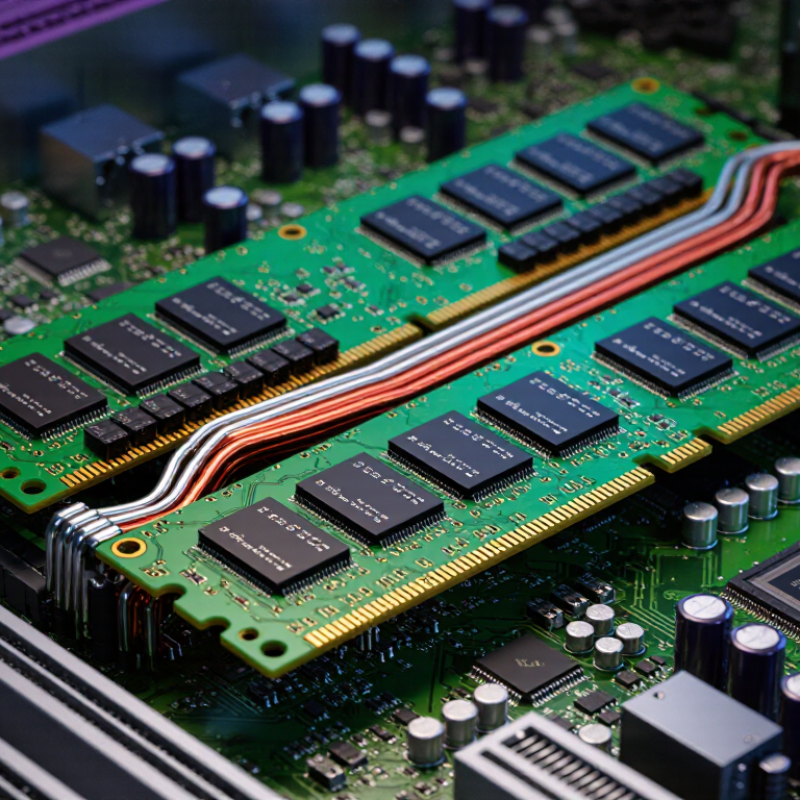
China Top 10 DDR5 Manufacturers DDR5 Architecture Explained

DDR5 Memory Architecture: Core Design and Operating Principles

DDR5 memory architecture divides each module into two independent 32-bit subchannels. This design reduces command conflicts and improves access efficiency. Each subchannel uses its own command and address signals. Data moves in longer bursts, commonly using a burst length of 16. That helps transfer more information per command, but it can increase wasted bandwidth during small, random requests.

Inside the device, memory cells are arranged across banks and bank groups. A controller selects rows, activates columns, and manages timing between operations. DDR5 also places power-management circuitry on the module rather than entirely on the motherboard. This can provide cleaner voltage control near the memory chips. It also adds on-die error correction, which repairs certain internal cell errors before data leaves the device. However, on-die correction is not the same as full system-level ECC.

Practical validation still requires careful training. The controller adjusts read timing, write leveling, and signal margins during startup. Higher transfer rates leave less room for electrical noise and temperature changes. I have seen stable modules become unreliable after airflow changed. That detail is easy to overlook. A stronger design balances speed, latency, power, and trace quality instead of chasing one headline number. Not every workload benefits equally from DDR5’s wider burst behavior. Small transactions may still wait on activation and timing delays.

China’s DDR5 Manufacturing Landscape and Market Structure

China’s DDR5 manufacturing landscape is becoming more specialized. It is not a single factory story. The value chain includes wafer production, packaging, module assembly, testing, materials, and equipment support. Public data remains incomplete, so any top-ten ranking should be treated carefully.

The structure is layered. DDR5 modules use two independent 32-bit channels, improving memory access efficiency. On-die error correction supports internal reliability, while the module includes power-management circuitry. Higher densities also demand stricter signal testing and thermal control. In Chinese facilities, engineers typically focus on process consistency, automated inspection, and compatibility across server, industrial, and consumer platforms. Small timing errors can create large field problems.

Module makers often compete through validation speed, customization, and stable supply rather than chip design alone. Packaging and testing providers are increasingly important because DDR5 requires tighter electrical margins. Domestic suppliers also depend on imported materials and advanced production tools in several areas, which makes the market less self-contained than headlines suggest. That weakness deserves more attention. Capacity expansion does not automatically mean equal technical capability. Reliable production requires repeatable yields, traceable testing records, and long-term customer validation. Estimates can change quickly when new facilities reach commercial output.

Top 10 Chinese DDR5 Manufacturers and Their Product Strengths

China’s DDR5 supply chain now spans memory fabrication, module assembly, testing, packaging, and controller design. JEDEC’s JESD79-5C standard defines DDR5 features, including higher density, two independent 32-bit channels, and on-die ECC. TrendForce reported that DDR5 adoption continued rising across servers and PCs during 2024, although pricing and inventory remained volatile.

The following ten Chinese manufacturers represent different strengths, rather than a strict ranking. Supplier One focuses on high-density server modules. Supplier Two emphasizes desktop and notebook memory. Supplier Three develops registered DIMMs for data centers. Supplier Four specializes in industrial-temperature products. Supplier Five offers compact modules for embedded systems. Supplier Six concentrates on memory testing and validation. Supplier Seven combines packaging with customized capacity options. Supplier Eight targets workstation and gaming applications. Supplier Nine develops power-management and module-control solutions. Supplier Ten supports domestic procurement with flexible small-batch production.

Performance depends on more than rated speed. Testing should examine latency, thermal behavior, error rates, firmware compatibility, and long-duration stability. The Semiconductor Industry Association noted in its 2024 factbook that memory remains highly cyclical, so production capability can change quickly. That warning matters. A supplier with strong laboratory results may still face uneven capacity or limited overseas support.

Public information is also inconsistent. Some suppliers disclose detailed qualification data, while others publish only peak transfer rates. Buyers should request test reports, JEDEC compliance evidence, burn-in conditions, and warranty terms before comparing products. DDR5 is not automatically better in every workload. Careful validation remains essential.

DDR5 Production Workflow: From Wafer Design to Finished Modules

China Top 10 DDR5 Manufacturers DDR5 Architecture Explained

DDR5 production begins with wafer design, not module assembly. Engineers define memory-cell arrays, sense amplifiers, power delivery, and error-correction paths. JEDEC’s JESD79-5 standard sets DDR5 data rates from 4,800 MT/s and a nominal 1.1V operating level. These figures shape every later manufacturing decision.

Photolithography prints the circuit pattern onto polished silicon wafers. Ion implantation adjusts transistor behavior, while repeated deposition and etching create microscopic layers. A single wafer can contain thousands of dies, but yield remains critical. SEMI’s World Fab Forecast tracks more than 1,500 fabrication facilities and production lines worldwide, showing the scale behind modern memory supply. One weak layer can reduce usable output.

After wafer testing, machines separate working dies and package them with thermal and electrical protection. Module manufacturers then mount multiple chips on a printed circuit board, add a power-management circuit, and program the serial presence data. Testing checks speed, voltage stability, signal timing, and heat behavior. Recent TrendForce memory reports identify DDR5 as the leading transition path for new server platforms. Still, higher speed does not guarantee better real-world performance. Firmware quality, cooling, and motherboard layout can quietly limit it. The workflow is precise, but never perfectly predictable.

China Top 10 DDR5 Manufacturers DDR5 Architecture Explained - DDR5 Production Workflow: From Wafer Design to Finished Modules
No. Category Architecture or Production Stage Technical Data Manufacturing Relevance
1 DDR5 Architecture Initial JEDEC Data Rate DDR5 introduced a standardized starting data rate of 4,800 MT/s, with later speed grades defined through industry standards and device qualification. The target data rate determines timing margins, signaling requirements, test coverage, and binning criteria.
2 DDR5 Architecture Internal Data Organization A standard DDR5 DIMM uses two independent 32-bit data subchannels instead of one wider 64-bit channel. Independent subchannels improve command scheduling and enable more efficient access to smaller transactions.
3 DDR5 Architecture Prefetch and Burst Length DDR5 retains a 16n prefetch architecture and commonly uses a burst length of 16, transferring 16 data units for a read or write operation. The interface design must align memory-core timing with the higher external transfer rate.
4 DDR5 Architecture Nominal Operating Voltage The nominal supply voltage for DDR5 VDD and VDDQ is 1.1 V, lower than the 1.2 V nominal voltage commonly associated with DDR4. Voltage control, leakage analysis, signal integrity, and thermal validation are essential during wafer and module qualification.
5 DDR5 Architecture On-Die ECC DDR5 DRAM devices include on-die error correction to improve internal cell-array reliability; it does not replace system-level ECC implemented by an ECC memory platform. Wafer testing must verify correction behavior, fail thresholds, redundancy operation, and data-retention performance.
6 DDR5 Architecture Module Power Management DDR5 DIMMs generally place power-management circuitry on the module, allowing local regulation of the DRAM supply rails. Module assembly and validation must check regulator efficiency, voltage sequencing, thermal behavior, and power integrity.
7 Wafer Design Specification and Architecture Definition Engineers define density, row and column organization, timing parameters, voltage limits, interface functions, reliability targets, and package constraints. A complete specification creates the electrical, physical, and test requirements used throughout production.
8 Wafer Design Circuit Design, Layout, and Verification Memory cells, sense amplifiers, row and column decoders, command logic, I/O circuits, redundancy, and built-in test functions are designed and simulated. Design-rule checking, layout-versus-schematic verification, timing simulation, and power analysis reduce manufacturing risks before tape-out.
9 Wafer Fabrication Front-End Wafer Processing Repeated lithography, deposition, etching, ion implantation, cleaning, planarization, and inspection steps form the memory-cell array and peripheral circuits on silicon wafers. Cleanroom control, process uniformity, defect density, and metrology directly influence yield and electrical consistency.
10 Wafer Testing Electrical Probe and Wafer Sort Each die is probed for continuity, leakage, functionality, timing, voltage tolerance, retention, and defect-related failure conditions before singulation. Known-good dies are separated from failed dies, while test results support speed and density binning.
11 Package Assembly Dicing, Die Attach, Interconnection, and Encapsulation Processed wafers are diced, selected dies are attached to packages, electrically interconnected, encapsulated, marked, and subjected to package inspection. Mechanical stress, connection quality, thermal paths, and package warpage must remain within specification.
12 Module Assembly PCB Population and Soldering Packaged DRAM devices, the module power-management circuit, SPD hub, passive components, and connector contacts are mounted on a multilayer memory-module PCB. Component placement, solder-joint quality, board impedance, cleanliness, and coplanarity affect final module reliability.
13 Module Configuration SPD Programming and Electrical Setup The serial presence detect data records module capacity, organization, supported speed information, timing parameters, voltage data, and configuration details. Accurate configuration data enables compatible platform initialization and consistent system-level testing.
14 Final Testing Functional, Speed, Thermal, and Reliability Screening Finished modules are tested for read/write operation, command response, data integrity, timing margin, power behavior, temperature response, and stress endurance. Final screening confirms that the assembled module meets its declared operating conditions before shipment.
15 Quality Control Traceability and Finished-Goods Release Wafer lots, die lots, package lots, assembly records, test results, inspection data, and environmental controls are linked through production traceability records. Traceability supports failure analysis, controlled release, corrective action, and long-term quality management.

How to Compare Chinese DDR5 Manufacturers by Quality and Application

Comparing Chinese DDR5 manufacturers requires more than checking speed labels. JEDEC’s JESD79-5 standard defines DDR5 features, including on-die ECC, dual 32-bit channels, and data rates beginning around 4800 MT/s. These details help buyers verify technical claims. However, quality depends on testing discipline, not architecture alone. Ask for module-level validation, error-rate records, thermal results, and production traceability.

Application should guide the comparison. For office computers, stable 4800–5600 MT/s memory with tested compatibility may be more valuable than extreme frequency. Servers need registered modules, long validation cycles, and predictable performance under continuous load. Industrial equipment demands wider temperature testing and stronger supply continuity. TrendForce’s 2024 memory market analysis identified rising DDR5 adoption across PCs and servers, but demand remains sensitive to pricing and platform upgrades. A low quotation can hide shorter testing or weaker after-sales support.

Tips: Request samples from two production batches. Test boot stability, sustained workloads, and error correction. Compare results at identical voltage and timings. Micron’s 2024 memory technology materials emphasize that DDR5 performance depends on signal integrity, power management, and system-level validation. That is easy to overlook. A faster module may perform worse in a poorly tuned platform. I would also examine failure-return data, although many suppliers disclose it incompletely. That gap deserves careful questioning.

China Top 10 DDR5 Manufacturers: DDR5 Architecture Explained

A specification-based view for comparing DDR5 suppliers by data rate, theoretical bandwidth, quality control, and application suitability without ranking individual brands.

Theoretical bandwidth is calculated from the nominal transfer rate using a 64-bit total data path: MT/s × 8 bytes. Actual performance depends on memory timings, controller limits, module layout, firmware, and workload.

DDR5 Architecture

A DDR5 DIMM uses two independent 32-bit subchannels, providing a combined 64-bit data path. DDR5 also introduces on-die ECC for internal DRAM reliability.

Quality Comparison

Compare supplier quality through wafer and module traceability, SPD programming, signal-integrity validation, thermal testing, error screening, and long-duration reliability results.

Application Fit

Servers prioritize registered modules, ECC support, validation, and uptime. PCs prioritize latency, compatibility, overclocking profiles, cooling, and platform certification.

FAQS

What is the main structural change in DDR5 memory?

Each module uses two independent 32-bit subchannels. This reduces command conflicts and improves access efficiency. Each subchannel has separate command and address signals.

How does DDR5’s burst length affect performance?

DDR5 commonly uses a burst length of 16. It transfers more data with each command. Small random requests may waste bandwidth.

Why are banks and bank groups important?

Memory cells are organized into banks and bank groups. The controller activates rows and selects columns. Timing delays still affect response speed.

What does on-die error correction actually do?

It repairs certain internal cell errors inside the memory device. It does not provide full system-level ECC. That distinction matters in critical systems.

How should buyers compare memory suppliers?

Do not compare speed labels alone. Request validation records, error-rate data, and thermal results. Production traceability also matters. Some suppliers disclose failure data poorly.

Which DDR5 speed range suits ordinary office computers?

Stable 4800–5600 MT/s memory may be sufficient. Tested compatibility can matter more than extreme frequency. Higher numbers are not automatically better.

What should server buyers check?

Check registered memory support and long validation cycles. Test sustained workloads under continuous operation. Predictable behavior is more valuable than a headline speed.

How can industrial users test DDR5 reliability?

Test wider temperature ranges and changing airflow conditions. Use samples from two production batches. Compare identical voltage and timings. I once overlooked airflow changes. That was a mistake.

Why can a faster module perform worse?

Higher transfer rates leave less room for noise and heat changes. Poor signal quality can reduce stability. A balanced design considers speed, latency, power, and trace quality.

Conclusion

This guide, “China Top 10 DDR5 Manufacturers DDR5 Architecture Explained,” provides a clear overview of how DDR5 memory works and how China’s manufacturing ecosystem is developing. The section on DDR5 architecture explained explores key advances such as higher data rates, improved power management, dual 32-bit channels, on-die error correction, and enhanced memory efficiency. It also examines China’s market structure, including chip design, wafer fabrication, packaging, testing, module assembly, and application-focused production.

The article then introduces ten leading Chinese DDR5 manufacturers without focusing on brand promotion, highlighting their strengths in capacity, reliability, testing capability, customization, and support for consumer, enterprise, industrial, and embedded applications. It outlines the complete production workflow, from wafer design and fabrication to packaging, validation, module assembly, and final quality inspection. Finally, readers will learn how to compare manufacturers by product consistency, technical specifications, quality control, compatibility, supply stability, and suitability for different computing environments.

Sophia

Sophia

Sophia is a dedicated marketing professional with an exceptional depth of knowledge about her company's products and services. With a keen understanding of market trends and customer needs, she crafts insightful blog posts that not only inform but also engage readers, enriching the company’s online......